

Tracking Vs Coaching: What Actually Changes Behavior?
- Blog
- Tracking Vs Coaching: What Actually Changes Behavior?
Tracking Vs Coaching: What Actually Changes Behavior?
Tracking records what happened. Coaching helps you understand what keeps happening and what to change next.
Tracking is useful.
It can help you see whether you showed up, how often you followed through, and where your consistency breaks down. Good tracking creates evidence. That matters.
But evidence alone does not change behavior.
Tracking answers the surface question
Tracking usually answers:
- Did I do it?
- How often did I do it?
- How long is the streak?
Those are not bad questions. They are just incomplete.
If you keep missing the same commitment, the deeper question is not whether the app recorded the miss. The deeper question is why the miss keeps repeating.
That is where coaching becomes different from tracking.
Coaching interprets the pattern
A coach can help you see things a tracker cannot explain:
- You do well when the goal is specific, but drift when it is vague.
- You start strong and then quietly overcommit by mid-week.
- You avoid the most emotionally loaded goal and compensate with easier wins.
- You tell yourself the week was unusually busy, but the same pattern shows up every third week.
None of that comes from a streak number alone.
It comes from context, memory, and reflection.
Tracking is passive. Coaching is active.
Most trackers wait for you to open them.
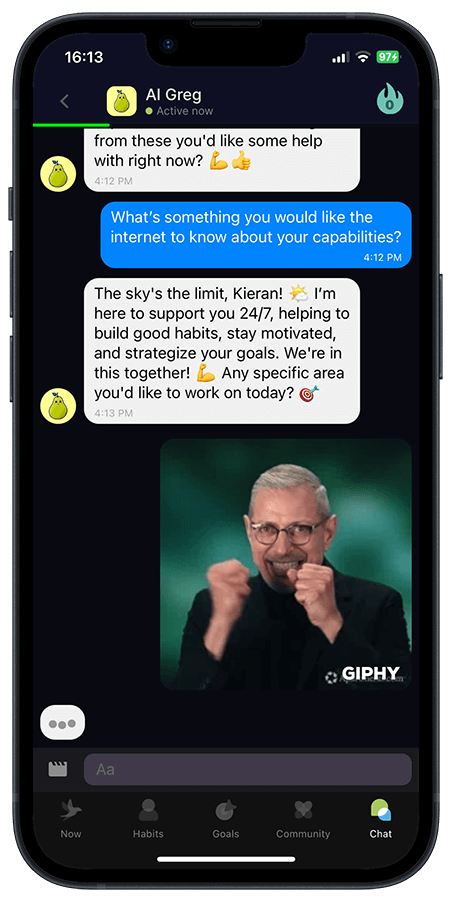
Coaching is different. A good coach can step into the week while it is still unfolding. It can challenge vagueness before you commit, nudge you when the pattern is starting again, and help you review the week in a way that changes the next one.
That active quality matters more than most people think.
Behavior rarely changes because you logged it beautifully after the fact. It changes because you were interrupted, challenged, or clarified before the week fully slid away.
Coaching changes the emotional experience
Tracking can easily become neutral administration.
Coaching feels more personal. That is not just a branding difference. It changes how the system lands emotionally.
Instead of feeling like you are updating a database, it feels like:
- someone is holding the week with you
- the plan means something
- your reflection matters
- your patterns are visible, not hidden
That emotional shift is one reason people stay longer with coaching systems than pure trackers.
The best systems still use tracking
This is not an argument against tracking.
Tracking is the raw material. Coaching is what turns the raw material into insight.
Without tracking, coaching loses signal.
Without coaching, tracking often becomes a sterile record of the same problems repeating.
What actually changes behavior
Behavior changes when people combine:
- a clear commitment
- evidence of what happened
- reflection on what got in the way
- support during the week
- a better reset into the next cycle
Tracking helps with one layer of that.
Coaching helps connect the rest.
If the goal is not just to measure your week but to get better at living it, coaching is what closes the gap.